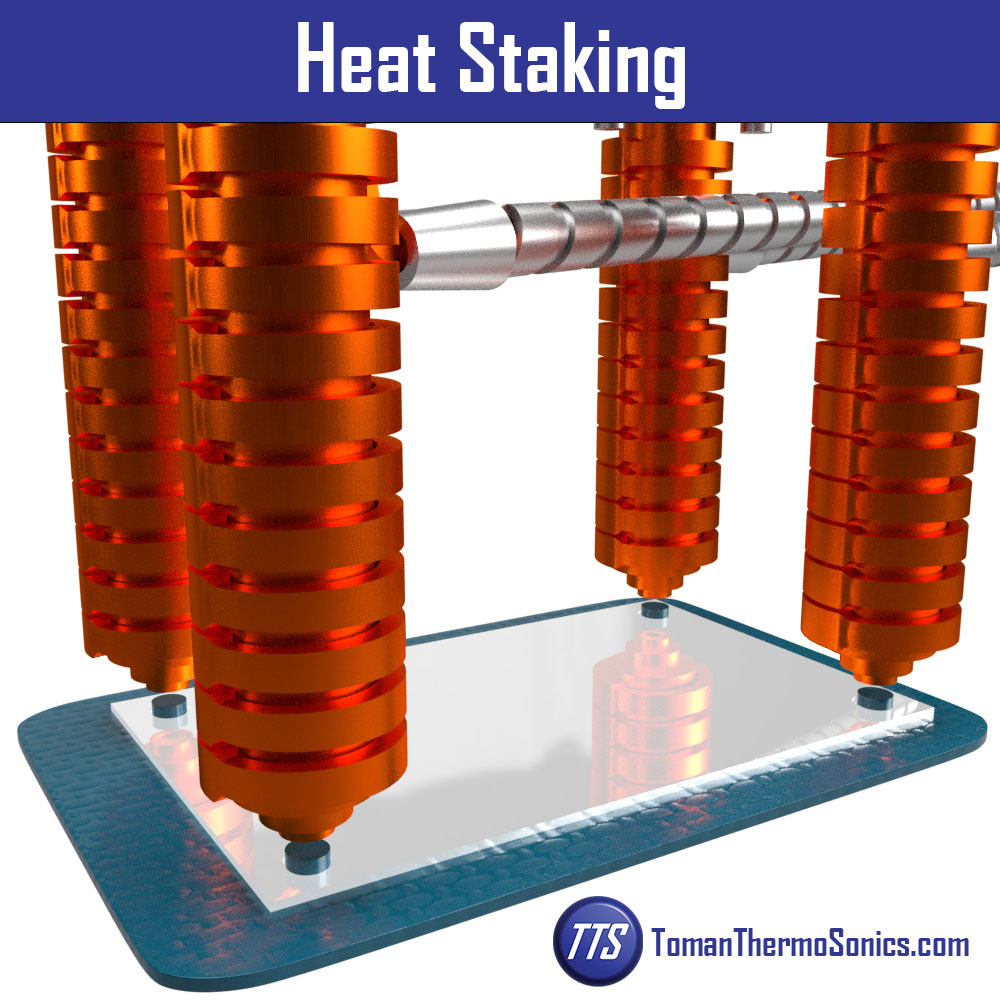


Temperature | Time | Force | Displacement | Cooling are the five variables of Heat Staking
Heat staking is sometimes reduced to a simple question: “What temperature should I use?”
For engineers, that is the wrong question.
A repeatable heat-staking process is the interaction of several controlled variables. Temperature is important, but it is only one part of the process. Temperature × Time × Force × Displacement × Cooling work together to determine how thermoplastic material flows, forms, and solidifies.
When these variables are properly controlled, heat staking can become a highly repeatable assembly process. When they are not, a process may produce parts that look acceptable while still experiencing inconsistent strength, dimensions, or long-term performance.
1. Temperature: Providing the Energy to Form the Stake
Temperature determines how the thermoplastic responds when heat is transferred into the boss.
The objective is not simply to heat the plastic as much as possible. Excessive temperature can cause unnecessary material degradation, deformation, flashing, or dimensional problems. Insufficient temperature may prevent the material from flowing properly, resulting in an incomplete or weakly formed stake.
The actual process temperature depends on factors such as:
-
- Thermoplastic material and grade
- Glass or mineral reinforcement
- Boss geometry
- Wall thickness
- Heat-tip geometry
- Heat transfer characteristics
- Required stake geometry
The heat tip therefore needs to deliver controlled and repeatable thermal energy, not merely reach a particular temperature.
2. Time: Controlling How Long the Material Receives Heat
Temperature alone does not determine how much thermal energy enters the plastic.
Time matters.
A relatively high temperature applied for a short period can produce a different result than a lower temperature applied for a longer period.
The heat-staking cycle must provide enough time for heat to penetrate the appropriate portion of the boss and allow the material to become sufficiently pliable for forming.
Too little time can result in incomplete material flow.
Too much time can transfer excessive heat into surrounding areas and potentially affect part dimensions or appearance.
This is why engineers should evaluate temperature and time together, rather than treating either variable independently.
3. Force: Controlling Material Movement
Once the thermoplastic reaches the appropriate forming condition, force controls how the material responds to the heat tip.
Force helps the tooling establish the required stake geometry and maintain contact during the forming process.
Too little force may produce incomplete or inconsistent forming.
Too much force can displace excessive material, deform the component, or create unwanted stress in the assembly.
The important engineering question is not simply:
“How much pressure does the machine have?”
It is:
“What force produces the required stake geometry without unnecessarily deforming the assembly?”
That distinction becomes especially important when working with thin-wall components, delicate substrates, or closely controlled cosmetic surfaces.
4. Displacement: Controlling the Geometry
Displacement is one of the most valuable—and sometimes overlooked—variables in heat staking.
Temperature tells you how hot the process is.
Force tells you how much forming force is being applied.
Displacement tells you how far the material is being formed.
For applications requiring consistent stake height or geometry, controlling the forming position can provide an additional level of process control.
Instead of relying entirely on an operator to determine when the stake “looks right,” the machine can be configured around a defined forming position.
This becomes particularly valuable in production environments where thousands or millions of assemblies must be produced consistently.
5. Cooling: Locking in the Final Geometry
The process does not necessarily end when the heat tip retracts.
The thermoplastic must cool sufficiently for the formed stake to retain its intended geometry and strength.
If the assembly is disturbed while the material is still too soft, the stake can deform or relax.
That makes cooling time an important process variable, rather than simply dead time between cycles.
Depending on the material and application, controlled cooling can improve dimensional consistency and reduce variation from part to part.
The Variables Are Interdependent
The biggest mistake is treating these five variables as independent settings.
They are a system.
Changing one variable can change the effect of the others.
For example, increasing temperature may reduce the amount of time required to form the material. Increasing forming force may alter the required displacement. Changing the cooling period can affect the final geometry even when the temperature, force, and displacement remain unchanged.
This is why establishing a reliable heat-staking process generally requires more than finding a single “correct” temperature.
The objective is to establish a process window in which reasonable variation in the manufacturing environment still produces acceptable assemblies.
A Better Way to Think About Heat Staking
Instead of asking:
“What temperature should we use?”
Engineers should be asking:
“What combination of temperature, time, force, displacement, and cooling consistently produces the required stake geometry and mechanical performance?”
That is a much more useful engineering question.
Building a Repeatable Process
A robust heat-staking process begins with understanding the material and the required finished geometry. From there, engineers can establish controlled parameters and evaluate the resulting stakes through dimensional inspection and appropriate mechanical testing.
The goal is not simply to make one good part.
The goal is to develop a process capable of making good parts repeatedly.
That distinction is what separates a successful prototype from a production-ready assembly process.
The Bottom Line
- Temperature starts the process
- Time controls heat exposure
- Force controls forming
- Displacement controls geometry
- Cooling stabilizes the result
Together, these five variables form the foundation of a controlled heat-staking process.
For engineers designing a thermoplastic assembly, understanding their interaction can be the difference between a process that merely works—and one that remains reliable throughout production.
Heat staking isn’t simply about applying heat to plastic. It is about controlling the entire forming process.